PDF Download Lincoln's Political Thought, by George Kateb
By clicking the link that we provide, you could take guide Lincoln's Political Thought, By George Kateb flawlessly. Connect to internet, download, as well as conserve to your tool. Just what else to ask? Reading can be so easy when you have the soft file of this Lincoln's Political Thought, By George Kateb in your device. You can likewise copy the data Lincoln's Political Thought, By George Kateb to your workplace computer or at home or even in your laptop. Merely discuss this great information to others. Suggest them to see this web page as well as get their looked for publications Lincoln's Political Thought, By George Kateb.
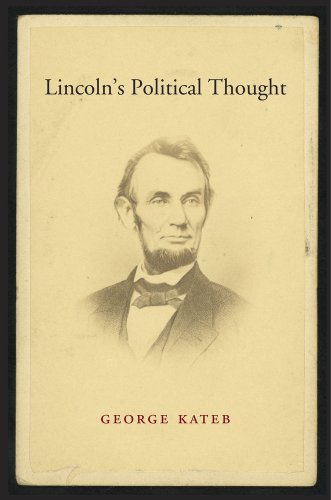
Lincoln's Political Thought, by George Kateb

PDF Download Lincoln's Political Thought, by George Kateb
How if there is a website that allows you to hunt for referred book Lincoln's Political Thought, By George Kateb from all around the globe publisher? Instantly, the site will certainly be unbelievable finished. Many book collections can be discovered. All will certainly be so simple without complicated thing to relocate from website to site to get the book Lincoln's Political Thought, By George Kateb really wanted. This is the site that will certainly give you those assumptions. By following this site you can obtain whole lots varieties of book Lincoln's Political Thought, By George Kateb compilations from versions types of writer as well as author prominent in this globe. Guide such as Lincoln's Political Thought, By George Kateb and also others can be obtained by clicking nice on link download.
It can be among your morning readings Lincoln's Political Thought, By George Kateb This is a soft file publication that can be got by downloading and install from on-line book. As understood, in this advanced age, modern technology will certainly ease you in doing some activities. Even it is just reviewing the visibility of book soft data of Lincoln's Political Thought, By George Kateb can be extra function to open. It is not only to open and save in the device. This moment in the early morning and also other spare time are to review the book Lincoln's Political Thought, By George Kateb
Guide Lincoln's Political Thought, By George Kateb will certainly consistently offer you positive worth if you do it well. Completing the book Lincoln's Political Thought, By George Kateb to review will certainly not become the only objective. The goal is by obtaining the good worth from guide up until the end of guide. This is why; you need to find out even more while reading this Lincoln's Political Thought, By George Kateb This is not only how fast you read a book as well as not just has how many you finished the books; it has to do with what you have actually acquired from the books.
Considering guide Lincoln's Political Thought, By George Kateb to check out is likewise required. You can choose guide based on the favourite themes that you like. It will involve you to enjoy reading other publications Lincoln's Political Thought, By George Kateb It can be additionally concerning the requirement that obligates you to review the book. As this Lincoln's Political Thought, By George Kateb, you can discover it as your reading book, also your favourite reading publication. So, discover your preferred book below as well as obtain the link to download guide soft data.
One of the most influential philosophers of liberalism turns his attention to the complexity of Lincoln’s political thought. At the center of Lincoln’s career is an intense passion for equality, a passion that runs so deep in the speeches, messages, and letters that it has the force of religious conviction for Lincoln. George Kateb examines these writings to reveal that this passion explains Lincoln’s reverence for both the Constitution and the Union.
The abolition of slavery was not originally a tenet of Lincoln’s political religion. He affirmed almost to the end of his life that the preservation of the Union was more important than ending slavery. This attitude was consistent with his judgment that at the founding, the agreement to incorporate slaveholding into the Constitution, and thus secure a Constitution, was more vital to the cause of equality than struggling to keep slavery out of the new nation. In Kateb’s reading, Lincoln destroys the Constitution twice, by suspending it as a wartime measure and then by enacting the Thirteenth Amendment to abolish slavery. The first instance was an effort to save the Constitution; the second was an effort to transform it, by making it answer the Declaration’s promises of equality.
The man who emerges in Kateb’s account proves himself adequate to the most terrible political situation in American history. Lincoln’s political life, however, illustrates the unsettling truth that in democratic politics―perhaps in all politics―it is nearly impossible to do the right thing for the right reasons, honestly stated.
- Sales Rank: #699698 in Books
- Published on: 2015-02-02
- Original language: English
- Number of items: 1
- Dimensions: 8.50" h x .80" w x 5.90" l, .0 pounds
- Binding: Hardcover
- 256 pages
Review
It is a delicate moral exercise, Kateb’s attempt to affirm Lincoln’s greatness while nonetheless chastening our idolatry and leaving us with a troubling image of ourselves. There are few writers since Emerson who have even attempted this sort of thing, let alone succeeded at it…Kateb refuses to simplify. The words in his book both bleed and provoke; his double-edged honesty cuts repeatedly against his own druthers, as he says what idolaters and debunkers alike wish not to hear…George Kateb has added a splendid and bracing chapter to [Emerson’s] Representative Men. (Jeffrey Stout Commonweal 2016-05-23)
Unforgiving and original. (David Bromwich Reuters 2015-04-14)
An erudite work that gently unravels the great man’s distortions and political expediency…The book is compelling throughout. (Kirkus Reviews 2014-12-08)
Kateb is the most interesting and important philosopher of liberalism alive today, and whatever he says is worth thinking about. Although I disagree, sometimes heatedly, with many of the arguments here, it’s also a book I’m going to continue to think about, a book I’m going to have with me for a very long time. (John Burt, author of Lincoln’s Tragic Pragmatism)
I have read quite a few Lincoln books over the past few years, and Lincoln’s Political Thought is the most enjoyable. For those who know Kateb’s work – and I have been a fan of his for a long time – all of his characteristic flourishes are here on display. (Steven Smith, editor of The Writings of Abraham Lincoln)
About the Author
George Kateb is William Nelson Cromwell Professor of Politics, Emeritus, Princeton University.
Most helpful customer reviews
7 of 7 people found the following review helpful.
A penetrating and nuanced evaluation of Lincoln's political thought
By Dallas Alice
This is a penetrating and nuanced evaluation of Lincoln's political thought. Kateb acknowledges Lincoln's intellect and political skills -- he believes Lincoln was probably the only person alive at the time who could have both saved the Union and freed the slaves -- but his is not an uncritical analysis; Kateb is sympathetic, but no cheerleader. Kateb's writing is both spare and elegant. This is a thin volume with many deep insights.
5 of 5 people found the following review helpful.
Masterful
By P. Stern
A powerful performance by a thinker of the utmost moral seriousness -- Kateb. To read this book is to listen to Kateb's voice in the lecture room, as I did long ago: acutely perceptive, morally freighted, and just slightly overwrought. The thoughts pass from Kateb's pen on to the page like worry beads. Kateb's analysis of the Second Inaugural Address is by itself worth the price of admission. Not an easy read, but richly stimulating. Highly recommended!
2 of 2 people found the following review helpful.
Nuanced About Lincoln And Open About Its Biases
By Nathan Albright
Given the wide variety of material about Abraham Lincoln, much of it highly variable in terms of its approaches and points of view, often what someone writes about Abraham Lincoln tells one more about the writer than about Lincoln himself. As this author says wisely, Lincoln was hard to pin down in terms of what he actually thought and felt in his largely political writings, largely because he did not want to be pinned down. His political speeches, many of which have endured because they make for thoughtful and deeply reflective writings worthy of careful textual analysis, are full of layers and complications and can be at times difficult to understand in their full contexts. Perhaps surprisingly, given the critical attitude the author takes towards Lincoln’s behavior as a president in terms of the precedents he set for later presidents like Wilson and others, and in his belief that Lincoln should have been an abolitionist, despite the fact that no thorough abolitionist politician could have been elected President of the United States, and therefore rid our republic of the stain of slavery, the author believes that Abraham Lincoln is the only man who could have been elected president who would have freed the slaves as early as he did. This leads to an ironic conclusion that even though the author is apparently a thoroughgoing secularist without any sort of religious beliefs, his argument reinforces Lincoln’s own occasional beliefs in the providential nature of his life and work, and even his martyrdom on behalf of freedom.
In terms of its structure, this book is organized in a thematic fashion, taking various speeches and private fragments as the relevant Lincoln canon for his political philosophy, and then using these texts to discuss a few related matters over the course of just over 200 pages of thoughtful material. The book contains seven chapters roughly equal in length, starting with the period of Lincoln, between 1854 and 1865 (the second act of his political career, although it does look back to earlier speeches like his Lyceum address and Sub-Treasury speech from his early political career). The author then examines Lincoln as a writer, Lincoln’s political religion of human equality, with which the author largely approves, even with the accusation of mild racism, and Lincoln’s views on race and human equality. The book then shifts gears and looks at Lincoln and the Constitution, as well as Lincoln’s doctrine of military necessity in the Civil War, and Lincoln’s world outlook. As a whole, the author appears to lament the suspension of various rights and privileges during the Civil War even if he agrees that Lincoln suspended those rights as mildly as possible given his fierce commitment to the Union, with the benefit of hindsight in our own erosion of freedom over the course of the 20th and 21st centuries.
Despite the fact that the book praises Lincoln in sometimes glowing terms, it often has what may be considered a strongly ambivalent approach towards Abraham Lincoln, and also it tends to overstate the level of color blindness in the Declaration of Independence while it simultaneously understates the genuine, if feeble, feeling against slavery that was present during the revolutionary period. This tendency to misrepresent American history, it should be noted, was largely due to what appears to be a hostility to the views of Jaffa (and also Fahrenbacher) that the crisis of the early American republic was due to the fact that a slaveholding people based their republic on the universal principle of the equality of all mankind with regards to the unalienable rights of life, liberty, and the pursuit of happiness (which may be seen as property, if one reads Locke and other related political philosophers), and this misrepresentation of the ethical standing of the American founding is done largely through taking Taney’s comments about the American view of blacks during the time of the Revolution and in 1857 at face value, which is unwise to do given the fact that Taney was not an honest historian in his Dred Scott decision. The abolitionism of the author tends to give much of this book’s content a certain strong feeling of self-righteousness that does not properly square with our own contemporary and widespread denial of the right to life for the innocent unborn that is at least as hypocritical as the denial of liberty to blacks during the antebellum period. Let him without sin cast the first stone. Overall, this book still manages to tell a lot about Abraham Lincoln, and also a lot about the author as well, including the fact that all generations are caught in the grip of deep tensions and contradictions that are not recognized at the time, and the fact that practical statesmanship, no matter how enlightened, often requires misdirection and even outright deception. Such is the price of attempting to lead virtuously as imperfect people in a fallen world.
Lincoln's Political Thought, by George Kateb PDF
Lincoln's Political Thought, by George Kateb EPub
Lincoln's Political Thought, by George Kateb Doc
Lincoln's Political Thought, by George Kateb iBooks
Lincoln's Political Thought, by George Kateb rtf
Lincoln's Political Thought, by George Kateb Mobipocket
Lincoln's Political Thought, by George Kateb Kindle

Tidak ada komentar:
Posting Komentar